
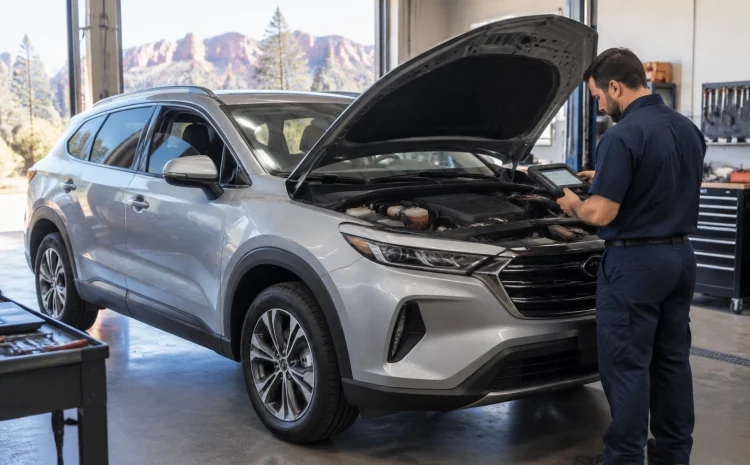
Hybrid Battery Fear: What Verde Valley Hybrid Owners Should Know Before the Big Repair
If your hybrid suddenly displays a “Check Hybrid System” message, your first thought may be, “How much is this going to cost?” That reaction is understandable. Hybrid vehicles combine a gasoline engine with high-voltage electrical components, and the battery is one of the most intimidating parts of the system.
The good news is that a warning light does not automatically mean you need a complete hybrid battery replacement. A weak 12-volt battery, cooling problem, wiring issue, sensor fault, or inverter concern can create similar symptoms. The right diagnosis matters before you approve a major repair.
For hybrid owners in Cottonwood, Cornville, Clarkdale, and throughout the Verde Valley, here is what to watch for and how to make a more informed repair decision.
What the Hybrid Battery Actually Does
A hybrid vehicle has more than one battery:
- A high-voltage hybrid battery powers the electric motor and stores energy from regenerative braking.
- A smaller 12-volt battery operates many familiar electrical systems and helps the vehicle’s computers turn on.
The high-voltage battery is made up of multiple cells or modules working together. As the vehicle accelerates, the battery may assist the gasoline engine. During braking, the system recovers some energy and sends it back to the battery.
This arrangement helps a hybrid use less fuel, especially in stop-and-go driving. However, the battery is still affected by age, heat, mileage, driving habits, and the condition of its cooling system.
A problem with either battery can trigger warning lights. That is why replacing the large hybrid battery should not be the first assumption.
Signs Your Hybrid Battery May Need Attention
Some symptoms are easy to dismiss at first. You may notice that the gasoline engine runs more often, the fuel economy drops, or the battery gauge moves unusually quickly between full and empty.
Pay attention to changes such as:
Hybrid warning lights
Your dashboard may display messages such as:
- Check Hybrid System
- Hybrid System Malfunction
- Service Hybrid System
- Hybrid Battery Warning
Some vehicles may also illuminate the check engine light, master warning light, or other system indicators. The exact wording and color depend on the manufacturer, so your owner’s manual is the best reference for what each warning means.
A hybrid warning light should not be ignored simply because the vehicle still drives normally. Some problems become more expensive when the vehicle continues operating with reduced cooling, charging, or electrical-system performance.
Declining fuel economy
A gradual change in fuel economy can happen for many reasons, including tire pressure, weather, traffic, air-conditioning use, and engine maintenance. But a persistent drop without an obvious explanation may point to reduced hybrid battery performance.
When the battery cannot hold or deliver energy as efficiently, the gasoline engine may need to work harder and run more frequently.
An unstable battery gauge
Does the battery state-of-charge display jump rapidly from nearly full to nearly empty? That can indicate reduced capacity or an imbalance between battery modules.
The gauge alone does not confirm a failed battery. It is one piece of information that needs to be evaluated alongside trouble codes, temperature readings, charging behavior, and road-test results.
Loud cooling fan noise
Hybrid batteries generate heat and use fans or ducts to regulate temperature. If you hear a constant fan-like sound from the rear seat or cargo-area region, the cooling system may be working harder than normal.
A blocked intake, dirty filter, restricted duct, or failing fan can contribute to battery overheating. In some cases, correcting the cooling problem may be less extensive than replacing the battery pack.
Sluggish acceleration or reduced electric assistance
A hybrid may feel less responsive when the battery is not providing its expected level of assistance. You might notice the issue while merging, climbing a hill, or accelerating from a stop.
Reduced performance can also result from engine, transmission, inverter, or sensor problems. A complete diagnostic is necessary before identifying the battery as the cause.
Why Arizona Heat Deserves Extra Attention
Extreme heat is hard on vehicle components, including both conventional and hybrid batteries. Cottonwood and the surrounding Verde Valley experience hot summer conditions that can place additional demands on battery cooling systems.
Heat does not mean your hybrid battery is destined to fail early. It does mean cooling and maintenance deserve attention.
The battery cooling intake should remain clear of dust, pet hair, luggage, clothing, and other debris. If the intake is located near a rear seat, avoid covering it with blankets or placing items directly over it. Your owner’s manual can show its exact location.
Routine maintenance also matters. Keeping the engine, cooling system, tires, and brakes in good condition reduces unnecessary strain on the hybrid system. You can review your vehicle’s maintenance needs with a shop that provides testing and inspection services and understands the importance of checking the complete vehicle: not just the warning light.
A Proper Diagnosis Is More Than a Basic Code Scan
A basic code reader may identify that a warning exists, but it may not provide enough information to determine the repair.
A thorough hybrid-system evaluation may include:
- Retrieving all relevant diagnostic trouble codes and manufacturer-specific data
- Testing the 12-volt battery and charging system
- Reviewing battery module or block voltage readings
- Checking battery temperature sensors
- Inspecting the battery cooling fan and air passages
- Looking for wiring, connector, fuse, or insulation concerns
- Evaluating charging and regenerative-braking behavior
- Road-testing the vehicle when appropriate
The 12-volt battery deserves special attention. A weak 12-volt battery can cause unusual warning lights, communication errors, and starting or “Ready” problems in some hybrids. Testing it early can prevent you from approving a much larger repair unnecessarily.
If a shop recommends a replacement, ask what the diagnostic results show. A trustworthy estimate should explain the problem in plain language and distinguish confirmed findings from possibilities.
Repair, Recondition, or Replace?
The best option depends on the vehicle’s age, mileage, battery design, condition, and the extent of the failure.
When a smaller repair may be appropriate
A full battery replacement may not be necessary when the root cause is:
- A weak 12-volt battery
- A blocked or failed cooling fan
- A damaged connector or wiring concern
- A sensor or fuse problem
- A charging-system or inverter-related issue
- A limited module failure that can be correctly addressed
Some hybrid battery specialists offer module-level repairs or reconditioned packs. These options may cost less initially, but they should be evaluated carefully. A battery with several aging modules may develop another problem soon after one module is replaced.
Ask about the expected reliability of the repair, the parts being used, the warranty, and whether the work is appropriate for your vehicle’s condition.
When replacement may make more sense
A complete replacement may be the more reliable choice when diagnostics show widespread degradation, repeated weak modules, severe imbalance, physical damage, or a battery that can no longer provide dependable performance.
The cost should be considered alongside the vehicle’s overall condition. A hybrid with a solid engine, transmission, body, and maintenance history may justify the investment. If the vehicle also needs major suspension, brake, air-conditioning, or engine repairs, it may be worth comparing the total repair cost with the vehicle’s value and your long-term plans.
This is where an honest conversation helps. You should receive options: not pressure.
Do Not Open the High-Voltage Battery Yourself
Hybrid batteries and orange high-voltage cables are not comparable to a standard 12-volt battery. Improper handling can cause severe injury or damage to the vehicle.
Do not remove the battery cover, disconnect high-voltage cables, or attempt a module replacement using online instructions unless you are properly trained and equipped for high-voltage automotive service.
If the hybrid warning light is red, the vehicle enters a reduced-power mode, produces smoke or unusual electrical odors, or refuses to enter Ready mode, move to a safe location and contact a qualified professional. Depending on the symptoms, towing may be safer than continuing to drive.
Firestone Complete Auto Care also recommends professional diagnosis for hybrid-system warning lights because the problem may involve the high-voltage battery, inverter, fuses, or the 12-volt system. You can review its general guidance on hybrid system malfunction warnings.
How 360 Automotive Can Help You Take the Next Step
A hybrid warning light can make any driver worry about the largest possible repair. At 360 Automotive, the goal is to make the diagnostic process clearer so you can decide what makes sense for your vehicle and budget.
Our team provides general auto repair and diagnostic services for domestic and Asian vehicles. We can evaluate related concerns, help identify the next diagnostic step, and explain what needs immediate attention versus what may be monitored.
If your vehicle is due for broader maintenance, reviewing its factory-recommended maintenance schedule can also help. Maintenance records, mileage, battery history, and the condition of the rest of the vehicle are all important when deciding whether a major repair is worthwhile.
Do Not Let Battery Fear Make the Decision for You
A hybrid battery warning is serious enough to investigate, but it is not an automatic sentence for an expensive replacement. The most responsible first step is a complete diagnosis that checks the 12-volt battery, cooling system, electrical components, and high-voltage battery data.
Whether you drive a hybrid around Cottonwood, commute from Cornville, or travel throughout the Verde Valley, getting clear information can help you avoid guessing. Schedule an inspection with 360 Automotive and let our team help you understand the condition of your vehicle before you commit to a major repair.